Overview
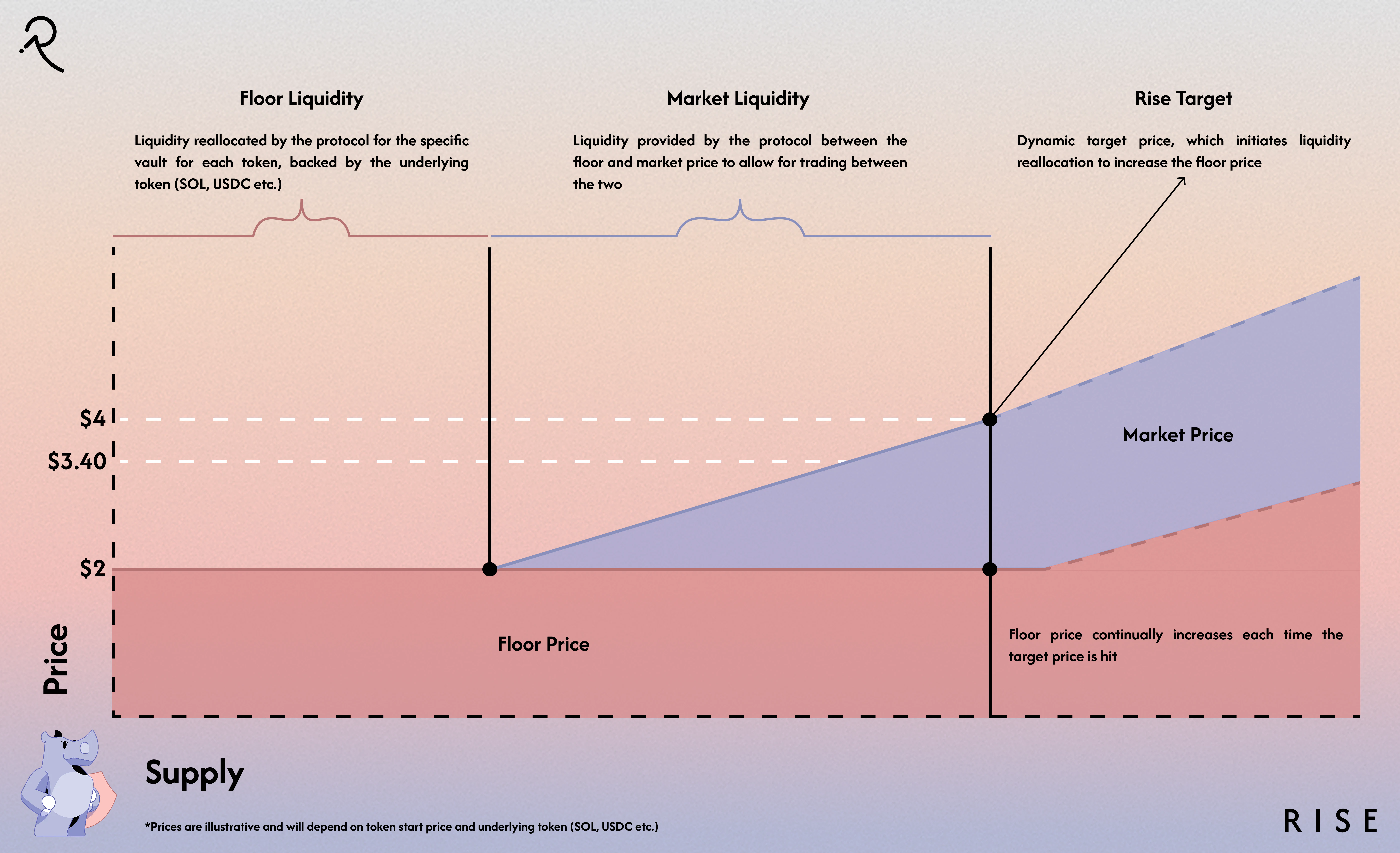
How liquidity is reallocated into the floor every time the RISE target is reached.
When the Floor Rises
The protocol has been designed with token maturity in mind. Initially, to prevent rugs, floor raises are immediate whenever sufficient liquidity is available to support them. After $100k of net inflows, the floor evolves to include a 30-second cooldown mechanism, whereby it rises by the maximum possible every 30 seconds when sufficient liquidity is available. After every subsequent $100k of net inflows, the cooldown period increases until it finally reaches a maximum of 120 seconds. As tokens mature, this mechanism allows for thicker liquidity between the market and floor price, while the floor catches up with price action. The design optimises the UX for traders who benefit from the increased liquidity depth, while still protecting early participants from “bundlers” and “ruggers”.How It Works
RISE uses an elastic supply model:- Every buy triggers the protocol to mint a fresh token at the current quoted price
- Every sell triggers the protocol to burn the sold token out of supply forever
Price Regions
RISE tokens operate across two distinct regions:Floor Price
Floor Price
A permanent redemption price backed by protocol reserves. Every token in circulation can be sold against it, no matter what.
- Backed by protocol-owned reserves
- Not dependent on external MMs or LPs
Market Price
Market Price
Above the floor, the protocol provides liquidity that enables price appreciation as supply increases. This is where normal trading occurs.
Solvency During Capitulation
Each token launched on RISE has its own isolated pool. There is no oracle risk and no cross-token contagion. The floor only rises when the protocol has verified it holds enough liquidity to back every single token in circulation against a sell at that price. This means:- The floor withstands the entire token supply being sold into it simultaneously
- Even in a complete capitulation, the last seller receives the floor price
- There is no scenario where the floor fails to fulfill sells